Choosing the right stamping die is an important decision when developing custom motor stator and rotor cores. The tooling method affects production efficiency, dimensional consistency, material utilization, manufacturing costs, and the transition from prototype development to mass production.
Progressive dies and transfer dies are both used in metal stamping, but they handle workpiece movement and processing differently. For motor core manufacturers, the appropriate choice depends on lamination geometry, material thickness, required production volume, stacking method, tooling investment, and the design of the finished core.
Yuma Precision provides progressive die solutions for motor core manufacturing and supports customized tooling development according to motor design and production requirements. Understanding the differences between these two stamping methods helps engineering and procurement teams make more informed tooling decisions.
What Is Progressive Die Stamping for Motor Cores?
Progressive die stamping uses a strip of metal that advances through multiple stations within a single die. Each station performs a specific operation, such as punching positioning holes, forming slots, cutting the outer profile, or completing other required features.
As the strip advances with each press stroke, successive operations are performed at different stations. Once the production line reaches steady operation, multiple workpieces are processed simultaneously at different stages.
For motor stator and rotor laminations, progressive dies can integrate multiple punching operations into one continuous production process. Depending on the die design, the process can also incorporate features for automatic stacking, interlocking, or other specialized lamination manufacturing requirements.
Key Characteristics of Progressive Dies
● Continuous production: The metal strip advances through multiple stations, supporting high-volume manufacturing.
● Integrated operations: Multiple punching and forming steps can be completed within one die system.
● Consistent positioning: A properly designed die and feeding system help maintain dimensional consistency across repeated production cycles.
● Automation potential: Progressive stamping can be integrated with automatic feeding, part collection, inspection, and compatible stacking equipment.
● Specialized tooling requirements: The die requires careful engineering, manufacturing, commissioning, and maintenance to maintain stable production.
Progressive die stamping is particularly worth evaluating when motor core designs are established and production demand justifies dedicated tooling investment.
What Is Transfer Die Stamping for Motor Cores?
Transfer die stamping uses a sequence of separate stations to perform successive operations on individual workpieces. After each operation, a transfer mechanism moves the workpiece to the next station.
Unlike progressive stamping, where the workpiece generally remains connected to the metal strip until separation, transfer stamping moves separated or individually handled workpieces between stations.
Depending on the component design, transfer dies can accommodate complex forming sequences, different part geometries, and operations that require more access to the workpiece at individual stations.
For motor core manufacturing, transfer tooling may be considered when the component geometry, forming requirements, or production process makes individual workpiece transfer more suitable than continuous strip feeding.
However, transfer die stamping is not automatically the better choice for motor laminations. Many flat stator and rotor laminations are well suited to progressive stamping. The decision should be based on the actual component design, tooling layout, stacking requirements, and production economics.
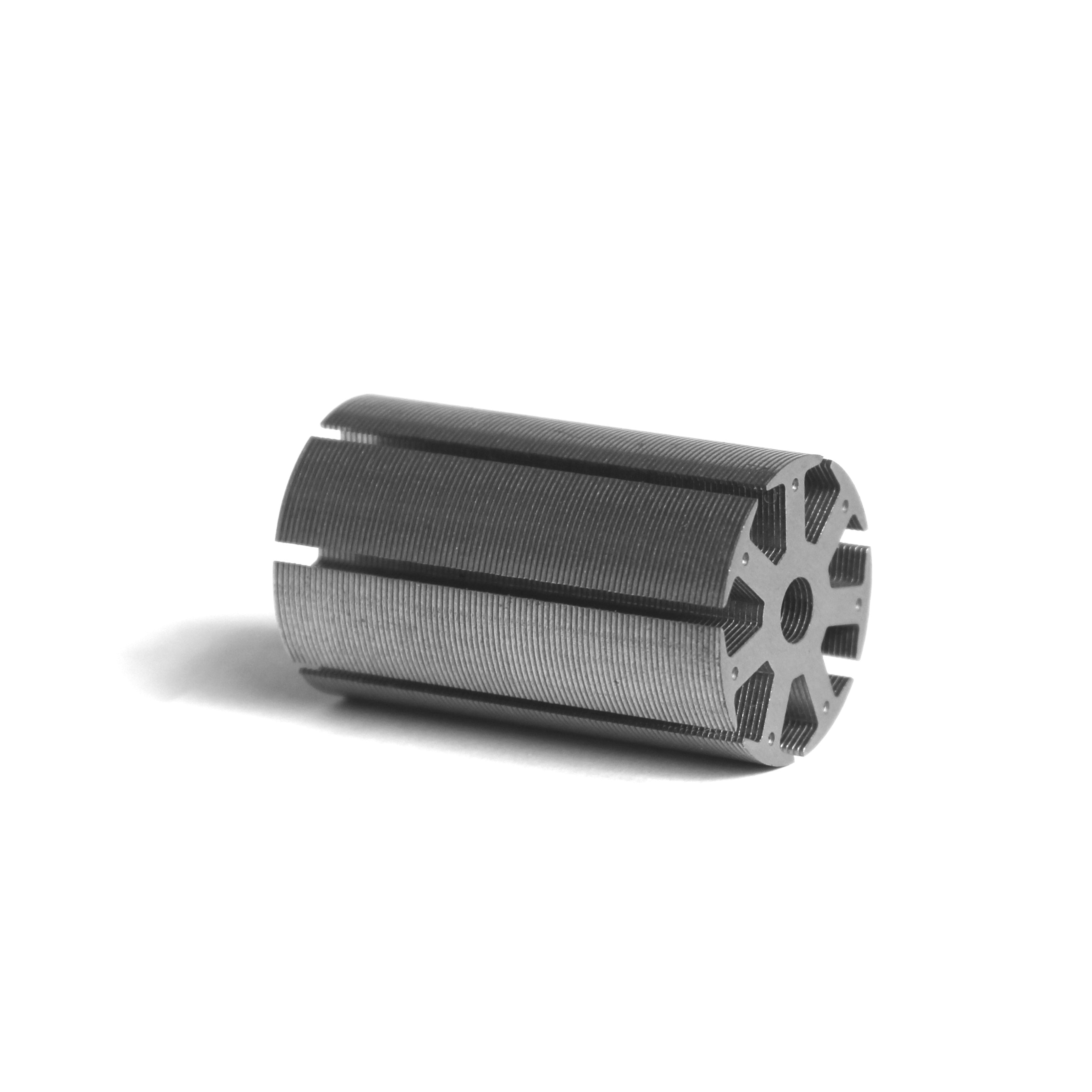
Key Characteristics of Transfer Dies
● Individual workpiece handling: Components are transferred between processing stations rather than remaining attached to a continuous strip throughout the sequence.
● Flexible station arrangement: Operations can be arranged according to the component's geometry and processing requirements.
● Access to complex features: Certain parts benefit from separate stations that provide suitable access for forming or other operations.
● Transfer system requirements: Automated transfer equipment and coordinated station operation must be considered in the overall production design.
● Application-dependent economics: Tooling, handling, cycle time, and maintenance costs depend on the specific component and production setup.
Transfer die stamping should be evaluated when the workpiece or processing sequence creates limitations for a conventional progressive die.
Progressive Die vs. Transfer Die: Key Differences
The most important distinction is how workpieces move through the stamping process. Progressive dies process a continuous strip through successive stations, while transfer dies move individual workpieces between separate stations.
| Comparison Factor | Progressive Die | Transfer Die |
|---|---|---|
| Workpiece Movement | Metal strip advances through the die | Individual workpieces move between stations |
| Production Method | Continuous strip stamping | Sequential processing with workpiece transfer |
| Production Efficiency | Well suited to high-volume continuous production | Depends on transfer speed, station layout, and component complexity |
| Tooling Design | Integrated multi-station die | Separate stations coordinated with a transfer system |
| Material Handling | Strip feeding and scrap management | Part transfer, positioning, and handling |
| Component Suitability | Particularly suitable for many flat, repetitive laminations | Worth evaluating for components requiring individual handling or complex processing |
| Automation | Can integrate feeding, stamping, and compatible stacking processes | Requires suitable transfer mechanisms and coordinated operation |
| Material Utilization | Depends on strip layout, part spacing, and scrap design | Depends on blank layout and material handling requirements |
| Initial Investment | Depends on die complexity, precision, and automation | Depends on station count, transfer equipment, and tooling complexity |
| Best-Fit Production | Established designs with suitable geometry and sustained production demand | Components whose geometry or process sequence benefits from individual transfer |
Neither process is universally superior. A technical and economic assessment should consider the finished core requirements, expected annual volume, tool life, production cycle, material consumption, and quality targets.
Which Stamping Process Is Better for Motor Stator and Rotor Laminations?
Motor core stamping involves more than producing the correct outer diameter. Slot geometry, tooth dimensions, shaft openings, positioning features, lamination thickness, and stacking requirements all influence the tooling design.
When Progressive Die Stamping Is a Good Choice
Progressive die stamping is often a strong candidate when:
● The stator or rotor lamination has a repeatable, primarily flat geometry.
● The project requires sustained medium- or high-volume production.
● Multiple punching operations can be integrated into a continuous strip process.
● Consistent positioning and dimensional repeatability are important.
● Automatic stacking, interlocking, or other compatible downstream operations can be integrated into the manufacturing process.
For established motor designs, progressive tooling can support a stable production process and reduce repeated manual handling.
Yuma Precision develops motor core progressive dies for motor stator and rotor lamination manufacturing, including tooling designed around customer-specific component geometry and production requirements.
When Transfer Die Stamping May Be Worth Evaluating
Transfer die stamping may be worth considering when:
● The component requires a sequence of operations that is difficult to integrate into a conventional progressive die.
● Individual workpiece handling provides better access to certain forming operations.
● The geometry or dimensional requirements require a specialized station arrangement.
● The production process involves workpiece shapes or handling requirements that make continuous strip processing less suitable.
The feasibility of transfer tooling should be reviewed against the specific motor core drawing. For conventional flat electrical steel laminations, progressive or other dedicated punching processes may be more appropriate.
How Tooling Choice Affects Motor Core Quality
The stamping method influences how consistently individual laminations can be produced. However, final motor core quality also depends on material properties, die condition, press accuracy, feeding stability, burr control, and the stacking or joining process.
Dimensional Accuracy and Slot Geometry
Stator slot dimensions, rotor geometry, and positioning features must match the motor design. Inconsistent punching dimensions can affect assembly, winding operations, air-gap control, and the repeatability of the finished core.
Tooling design should therefore account for the required tolerances, material thickness, cutting clearance, and inspection method.
Burr Height and Edge Quality
Punching creates cut edges that must be controlled to meet the component's requirements. Excessive burrs can interfere with stacking, insulation, assembly, and downstream processes.
The die design, cutting clearance, tool material, press conditions, and maintenance schedule all contribute to edge quality. Inspection criteria should be defined before production approval.
Lamination Stacking and Core Height
The final core depends on the thickness and flatness of individual laminations, as well as their alignment and stacking method.
Depending on the motor design, the manufacturing process may use loose-sheet stacking, mechanical interlocking, welding, bonding, or another specified joining method.
The die must be designed around the selected stacking process rather than treating stamping and stacking as unrelated operations.
Yuma Precision's broader motor core stamping capability covers tooling, precision punching, process control, and production requirements that influence the consistency of stamped laminations.
Tooling Investment vs. Production Volume
The most suitable die type should be evaluated over the expected production lifecycle, not only by the initial tooling quotation.
| Cost Factor | Questions to Review |
|---|---|
| Initial Tooling Investment | What are the die design, manufacturing, assembly, and commissioning costs? |
| Production Volume | How many laminations or finished cores are required annually? |
| Cycle Time | What production rate can the proposed process achieve under actual operating conditions? |
| Material Utilization | How much electrical steel is consumed per acceptable part? |
| Tool Maintenance | What inspection, sharpening, repair, and replacement work is expected? |
| Quality Costs | What are the risks of scrap, dimensional variation, and rework? |
| Automation | What feeding, transfer, stacking, and inspection equipment is required? |
| Product Changes | How likely are drawing revisions or future changes to slot and core geometry? |
For lower-volume projects or designs that are still being validated, a simpler tooling approach may reduce the initial commitment. Once the design is stable and production demand increases, progressive tooling may become more attractive.
The actual break-even point depends on tooling costs, production efficiency, material utilization, maintenance, and the cost of nonconforming parts. It should be calculated using project-specific data rather than a universal volume threshold.
What Should Be Confirmed Before Ordering Motor Core Stamping Dies?
Before requesting a tooling quotation, prepare the information needed to assess manufacturing feasibility.
● Component drawings: Provide the stator or rotor lamination drawings, including the outer diameter, inner diameter, slots, holes, and critical tolerances.
● Material specifications: Identify the electrical steel grade, thickness, coating requirements, and relevant material standards.
● Stacking requirements: Specify the finished core height, stacking method, interlocking features, skew requirements, or other joining details.
● Production demand: Provide the required sample quantity, expected annual volume, and target production schedule.
● Quality requirements: Define critical dimensions, acceptable burr height, flatness, and the required inspection documentation.
● Tooling and equipment constraints: Share the available press specifications, production line requirements, and any restrictions on die dimensions or automation.
● Development stage: Clarify whether the project is at concept design, prototype validation, pilot production, or established mass production.
These details allow the tooling supplier to evaluate whether progressive die stamping, transfer die stamping, or another process is the most suitable option.
How Yuma Precision Supports Motor Core Tooling Projects
Yuma Precision specializes in motor core and tooling development, with capabilities covering die design, tooling manufacturing, sample development, precision stamping, and related motor core manufacturing processes.
The company offers progressive die development and other tooling solutions for motor stator and rotor laminations. Its mold development capability includes different tooling approaches for sample development and production, allowing the manufacturing route to be assessed according to the component design and expected production demand.
For custom motor core projects, the tooling evaluation should consider lamination geometry, electrical steel specifications, stacking requirements, production volume, and quality targets. This helps establish a suitable process before committing to dedicated tooling.
Whether a project requires a new progressive die, an alternative stamping arrangement, or a transition from sample production to volume manufacturing, Yuma Precision can review the supplied drawings and technical requirements to determine the appropriate next steps.
Frequently Asked Questions
Is a progressive die always better for motor core stamping?
No. Progressive dies are well suited to many repetitive flat motor laminations and high-volume production requirements. The best option depends on component geometry, required operations, production volume, and tooling economics.
What is the main difference between progressive die and transfer die stamping?
Progressive stamping advances a continuous metal strip through multiple stations. Transfer stamping moves individual workpieces between separate stations. The difference affects material handling, station design, automation, and suitability for particular component geometries.
Can progressive dies support automatic motor core stacking?
Yes, progressive tooling can be designed to support compatible automatic stacking or interlocking processes. The available functions depend on the die design and the required finished-core construction.
Which process is more economical for high-volume motor core production?
Progressive stamping is often worth evaluating for high-volume production because it can integrate multiple operations into a continuous process. However, total cost depends on tooling investment, cycle time, material utilization, maintenance, and quality requirements.
What information is needed for a custom die quotation?
Provide the component drawings, material grade and thickness, critical tolerances, stacking requirements, expected production volume, sample requirements, and available press specifications. This information helps establish the appropriate tooling route and quotation scope.
Request a Motor Core Tooling Review
Choosing between progressive die and transfer die stamping requires a clear understanding of the component geometry, production volume, quality requirements, and manufacturing constraints.
Send Yuma Precision your motor stator or rotor lamination drawings, material specifications, annual demand, and stacking requirements. The engineering team can review the manufacturing feasibility and discuss a suitable tooling and production approach.
Contact Yuma Precision to discuss custom motor core stamping dies, sample development, and mass-production requirements.