Approving motor core samples is a critical step before committing to production tooling, large-volume orders, or a long-term supply agreement. A sample may look correct and match several drawing dimensions, but that alone does not prove it will meet assembly requirements or remain consistent throughout mass production.
For motor manufacturers, sample evaluation should cover dimensional accuracy, electrical steel specifications, stamping quality, stacking performance, assembly compatibility, and any application-specific testing requirements. The objective is to confirm that the sample meets the agreed technical criteria and that the manufacturing process can reproduce the approved design reliably.
Yuma Precision supports custom motor core and lamination projects through tooling development, precision stamping, and manufacturing process evaluation. Reviewing sample requirements early helps align engineering, quality control, and procurement teams before production approval.
1. Confirm the Drawing and Material Specifications
Before inspecting a motor core sample, establish the exact technical requirements against which it will be evaluated. Without an approved drawing and material specification, different parties may interpret acceptable dimensions or construction details differently.
● Drawing revision: Confirm the part number, drawing revision, critical dimensions, geometric tolerances, and any approved deviations.
● Electrical steel grade: Verify the specified material grade, thickness, coating requirements, and supporting material documentation where required.
● Lamination design: Check the stator or rotor profile, slot geometry, bore diameter, outer diameter, tooth dimensions, and locating features.
● Stacking requirements: Confirm the finished core height, lamination count where specified, stacking arrangement, and joining method.
● Application requirements: Identify any special requirements related to motor assembly, air-gap geometry, magnetic performance, noise, vibration, or operating temperature.
The physical sample, drawing, material information, and inspection results should refer to the same revision and configuration. This creates a clear technical baseline for approval and subsequent production.
2. Inspect Critical Dimensions and Geometric Accuracy
Dimensional inspection is one of the first steps in evaluating stamped motor core samples. Small deviations in lamination geometry can affect winding space, assembly fit, rotor positioning, and the consistency of the magnetic circuit.
The inspection plan should identify the critical characteristics and the appropriate measurement methods before samples are submitted for approval.
| Inspection Item | What to Check | Why It Matters |
|---|---|---|
| Outer Diameter | Diameter and profile against the drawing | Supports housing fit and assembly positioning |
| Inner Diameter or Bore | Diameter, roundness, and specified tolerances | Affects shaft or rotor fit and concentricity |
| Slot Width and Shape | Slot dimensions and profile | Influences winding space and manufacturing compatibility |
| Tooth Width and Geometry | Tooth dimensions and profile | Helps maintain the intended magnetic circuit geometry |
| Hole and Feature Position | Position relative to specified datums | Supports alignment and assembly |
| Lamination Thickness | Material thickness against the specification | Affects stacking height and core construction |
| Flatness | Flatness under the agreed measurement conditions | Helps identify distortion that may affect stacking |
| Finished Core Height | Axial dimension of the assembled stack | Supports assembly fit and design requirements |
Measurement results should be compared with the tolerances on the approved drawing. If a dimension falls outside the specified limit, determine whether the sample requires correction, a documented engineering deviation, or rejection.
For thin laminations, the measurement method and support condition should also be consistent. Otherwise, differences in how the sample is held or measured may influence the reported results.
3. Evaluate Stamping Quality and Burr Control
The condition of stamped edges is important because motor laminations are stacked closely together and may include thin insulating coatings. Burrs, deformation, and damaged edges can affect stacking quality and, in some designs, electrical insulation between adjacent laminations.
During sample inspection, review the following characteristics:
● Burr height and direction: Check the agreed measurement locations and acceptance limits, especially around slots, teeth, and critical edges.
● Edge deformation: Look for bent teeth, distorted profiles, cracks, or other defects that may affect assembly.
● Surface condition: Inspect for scratches, contamination, corrosion, and damage to the specified coating.
● Punching consistency: Compare the dimensions and edge condition of multiple samples rather than relying on a single selected part.
● Tool-related defects: Investigate repeated dimensional deviations, abnormal burrs, or recurring profile defects that may indicate a tooling or process issue.
Acceptable burr limits should be defined according to the component design and application. There is no single universal burr-height limit suitable for every motor lamination.
If the sample does not meet the agreed criteria, the supplier should identify the cause and confirm corrective actions before approval.
4. Verify Material Quality and Electrical Steel Requirements
A motor core's performance depends on both its geometry and the electrical steel used to manufacture it. A sample with acceptable dimensions may still be unsuitable if the material grade, thickness, or coating differs from the approved specification.
Material verification should include:
● Material grade and thickness: Confirm that the supplied steel matches the specified grade and nominal thickness.
● Material traceability: Where required, ensure the material documentation can be linked to the sample or production lot.
● Insulation coating: Check the specified coating type and inspect for visible damage caused by handling or stamping.
● Magnetic properties: Where the project specifies magnetic performance requirements, confirm the applicable test method, acceptance criteria, and supporting results.
● Material substitutions: Any proposed change in grade, thickness, coating, or source should be reviewed and approved before it is incorporated into production.
Core loss, permeability, and other magnetic characteristics should not be assumed from visual inspection alone. If these properties are critical to the motor design, they should be evaluated using the agreed test method and appropriate reference conditions.
5. Check Stacking Quality and Finished Core Construction
For assembled stator and rotor cores, inspecting individual laminations is not enough. The finished stack must also meet the specified dimensions, alignment, and construction requirements.
The stacking process can influence the final core height, flatness, mechanical stability, and consistency of the assembled component.
| Evaluation Item | Inspection Focus |
|---|---|
| Stack Height | Compare the finished axial dimension with the specified tolerance |
| Lamination Alignment | Check alignment of the bore, outer profile, slots, and other relevant features |
| Stack Flatness | Inspect the assembled faces under the agreed conditions |
| Interlocking or Joining | Verify that the specified interlocking, bonding, welding, riveting, or other method is correctly implemented |
| Mechanical Stability | Check for looseness, separation, distortion, or other unacceptable conditions |
| Coating and Insulation | Inspect for damage associated with stacking or joining |
| Finished Appearance | Identify contamination, corrosion, handling damage, and visible defects |
Where the motor design requires a specific stack compression condition or joining process, these details should be included in the acceptance criteria.
The evaluation should also clarify whether the supplier is responsible for individual laminations, the stacked core, or the complete assembled component. This prevents gaps in responsibility between stamping and downstream assembly.
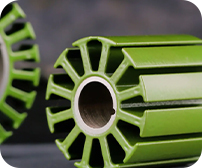
6. Test the Sample in the Intended Motor Assembly
A motor core sample should be evaluated in the context of its intended application whenever the project requirements call for assembly or functional validation.
Dimensional compliance is important, but the sample must also fit and function with the corresponding motor components.
Depending on the motor design and development stage, relevant checks may include:
● Winding compatibility: Verify that slot dimensions and geometry support the intended winding or conductor insertion process.
● Stator and rotor assembly: Check fit, positioning, alignment, and compatibility with mating components.
● Air-gap consistency: Where relevant, verify that the assembled stator and rotor geometry supports the specified air-gap requirements.
● Mechanical behavior: Evaluate relevant rotational clearance, runout, vibration, or other assembly-related characteristics where required.
● Thermal performance: For projects requiring motor-level validation, assess temperature rise under the agreed test conditions.
● Electromagnetic performance: Where required, evaluate torque, speed, core loss, or other specified motor performance parameters.
Not every project requires every test. The validation plan should reflect the motor design, critical-to-quality characteristics, and the customer's acceptance requirements.
If the supplier provides only stamped laminations or an unassembled core, full motor performance testing may need to be conducted by the motor manufacturer or another designated party.
7. Confirm That Sample Quality Can Be Reproduced in Mass Production
One of the most important questions before approving motor core samples is whether the same quality can be maintained after production volume increases.
A prototype may be produced under different conditions from the final production process. For example, the sample may use a different tooling arrangement, material batch, press setup, or inspection method.
Before mass production, confirm the following:
● Manufacturing route: Establish the intended tooling, stamping process, stacking method, and relevant production equipment.
● Material consistency: Confirm the approved material specification and the controls used to prevent unauthorized substitutions.
● Process inspection: Identify which critical dimensions and characteristics will be checked during routine production.
● Tool maintenance: Define the relevant inspection, maintenance, and correction procedures for production tooling.
● Production sampling: Agree on sample quantities, inspection frequency, and the criteria used to evaluate production consistency.
● Change control: Specify which changes in material, tooling, manufacturing route, or critical dimensions require customer notification or renewed approval.
Where the project risk or production volume justifies it, a production-intent trial run can provide additional evidence that the process is ready for routine manufacturing.
A successful sample approval is an important milestone, but it does not by itself prove long-term process capability. Ongoing quality control and traceable inspection records remain necessary.
8. What Documents Should Be Included in a Motor Core Sample Approval Package?
A clear approval package makes it easier for engineering, procurement, and quality teams to reach the same decision.
| Document or Record | Purpose |
|---|---|
| Approved Drawing | Establishes the required geometry and tolerances |
| Material Specification | Defines the required electrical steel grade, thickness, and coating |
| Dimensional Inspection Report | Records measured values for agreed critical characteristics |
| Visual Inspection Record | Documents surface condition, burrs, deformation, and other relevant defects |
| Material Documentation | Supports material verification and traceability where required |
| Stacking Inspection Report | Confirms finished core dimensions and construction where applicable |
| Functional Test Results | Records application-specific testing required by the project |
| Approved Deviation Record | Documents any authorized departures from the original specification |
| Sample Approval Record | Identifies the accepted sample, revision, and approval status |
The scope of documentation should be agreed before sampling begins. Not every project requires every document, and material certificates or test reports should only be requested or promised where they are applicable to the product and order.
9. A Practical Checklist Before Releasing Mass Production
Use the following checklist to confirm that the main approval requirements have been addressed.
| Approval Checkpoint | Acceptance Question |
|---|---|
| Drawing and Revision | Does the sample match the approved drawing revision? |
| Material | Is the material consistent with the specified grade, thickness, and coating? |
| Critical Dimensions | Do all required measured features meet the agreed tolerances? |
| Stamping Quality | Are burrs, deformation, and surface defects within the defined limits? |
| Stack Construction | Does the finished core meet the required height, alignment, and joining specifications? |
| Assembly Compatibility | Has the sample passed the required fit and functional checks? |
| Production Route | Will mass production use the approved manufacturing process and materials? |
| Quality Control | Are inspection methods, sampling frequency, and reaction procedures defined? |
| Documentation | Are the required inspection and material records complete? |
| Final Approval | Have unresolved issues and deviations been reviewed and formally accepted? |
Mass production should proceed only after the applicable approval requirements have been met and the responsible parties have documented their decision.
How Yuma Precision Supports Custom Motor Core Projects
Yuma Precision provides motor core manufacturing and tooling solutions for customer-specific stator and rotor requirements. The evaluation of sample quality should begin with the component drawing, material specification, critical tolerances, and intended production route.
For projects involving new tooling, Yuma Precision's progressive die solutions can be reviewed alongside the broader motor core stamping capability to understand the available manufacturing approaches.
The appropriate process depends on the lamination geometry, material specifications, production demand, stacking requirements, and quality criteria. Agreeing on these details before sample approval helps reduce uncertainty when moving from development to volume production.
Whether the project requires prototype evaluation, a new stamping die, or a transition to repeat production, providing complete technical information helps establish a clear basis for manufacturing review.
Frequently Asked Questions
Why should motor core samples be evaluated before mass production?
Sample evaluation helps identify dimensional deviations, material discrepancies, stamping defects, stacking issues, and assembly problems before they affect larger production quantities. It also establishes the technical baseline for the approved product.
Which dimensions are most important when inspecting motor core samples?
Critical dimensions depend on the motor design. Common inspection points include outer diameter, bore diameter, slot geometry, tooth dimensions, feature positions, lamination thickness, and finished stack height where applicable.
Should magnetic properties be tested during sample approval?
Magnetic testing should be included when the project specifies magnetic performance requirements or when the material or core design requires verification. The applicable properties, method, and acceptance criteria should be agreed before testing.
Is one approved sample enough to authorize mass production?
Not necessarily. One sample may demonstrate that a particular part can meet specified requirements, but it does not automatically prove that the production process will maintain consistent quality. The approval plan should account for production-intent conditions, risk, and repeatability requirements.
What is the difference between sample approval and production validation?
Sample approval confirms that the submitted sample meets the agreed acceptance criteria. Production validation provides additional evidence that the intended manufacturing process can reproduce the approved design under representative production conditions.
What information should be sent when requesting a motor core sample evaluation?
Provide the current drawing, material grade and thickness, critical tolerances, stacking requirements, expected production volume, required inspection records, and any application-specific testing requirements. This information helps establish a clear evaluation plan.
Request a Motor Core Sample Evaluation
Preparing a custom motor core for mass production? Yuma Precision can review your component drawings, material requirements, dimensional tolerances, stacking specifications, and production objectives to help clarify the manufacturing requirements.
Send your stator or rotor lamination drawings, sample requirements, expected annual quantity, and quality criteria for a project-specific discussion.
Contact Yuma Precision to discuss motor core sample evaluation, tooling development, and the transition from prototype approval to mass production.